
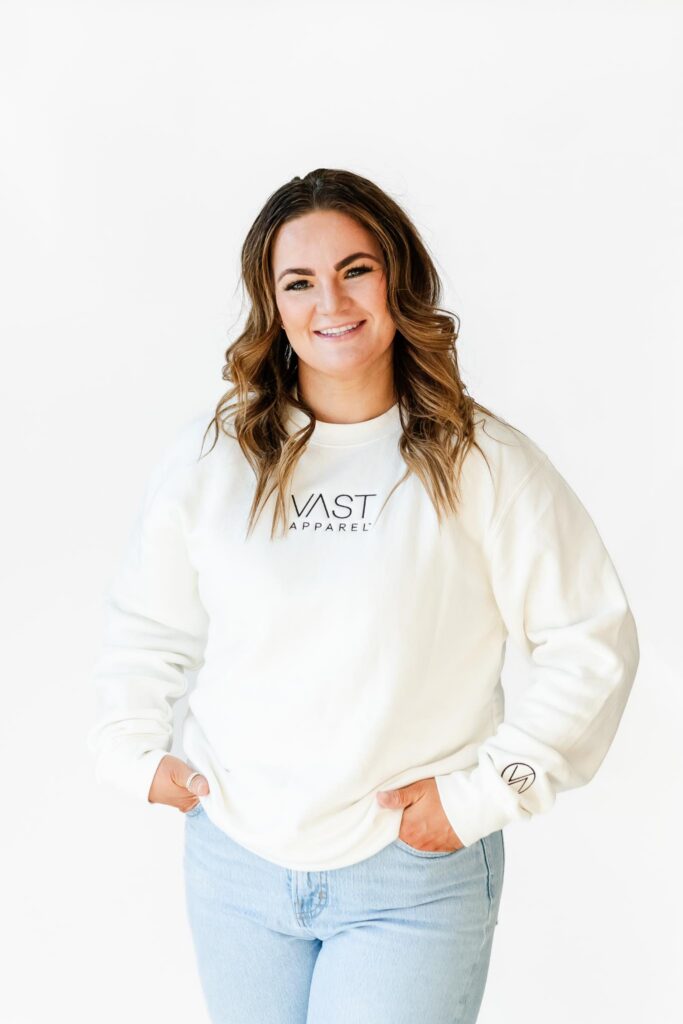
Day 1 – Breakout Session 1 – 9:45-10:15 AM
Room: Wildfire
The Goal Is Not a Business That Depends on You
China Hansen · RizeCon 2026 · Pocatello
Four years ago, China Hansen was printing 1,000 shipping labels from a desk in the middle of her warehouse — the day before she was scheduled to be induced. She was the only person who knew how to use the software and the printer their business depended on. Twenty employees were moving around her. She had a baby the next morning and was back Monday to print more labels. She called it miserable success: making money, building something real, and being completely unable to step away from the machine.
China is the founder and CEO of Little Mama Shirt Shop, a direct-to-consumer e-commerce brand she started with $400 in her guest bedroom that grew to a multimillion-dollar business within three years, and Vast Apparel, the corporate custom-apparel side of the operation. They now run 12,000 square feet with two brands, one team, and one warehouse — and last year paid out 35,000 hours in payroll. That number is the point. There’s no version of that math where one person does it all.
What she covered
Lead with vision — every time, every conversation. China opens every meeting with vision: the yearly retreat, monthly meetings, weekly check-ins, one-on-ones, and especially the hard conversations. Her definition is simple: what you’re building and why it matters. The two questions sound easy until you try to answer them under the pressure of running a business. And if you can’t answer them, she asked directly, how would you ever expect your team to? There is a statistic she cited: you have to share your vision with your team six times before they feel like they’ve heard it once. Because every day at work, they are asking themselves what’s in it for them. That’s not a selfish question. They are spending their lives in your company. It’s your job to tie their growth to yours.
Invest in your people — not only financially. The raise conversation has a short window. The moment an employee hears about a raise is the peak of excitement — by the time it hits their bank account, the feeling is mostly gone. Investment means more: vision exercises during work hours, hiring a business coach for key employees, inviting feedback on processes, weekly wins at the end of every Friday, and starting each week with intention. China runs a four-quadrant personal vision exercise with her team — physical, spiritual, professional, and personal — because she believes people do better work when they’re dialed in on all four areas of their life. Her team is mostly moms. They’ve lived five lifetimes before they walk in at 8:30. She’s not pretending that isn’t true.
Delegate and elevate. China gave the room three questions to sit with: What are you currently holding onto that you shouldn’t be? Who could own it? What’s stopping you from letting it go? She was clear that delegation doesn’t make leaders feel less busy — it makes their capacity bigger, which means more and higher-level work lands on their plate. Delegating is itself a job. The warning underneath all of it: you cannot delegate chaos. Organize it first, then hand it off. Give people real roles that require real ownership, and then let them own them.
Build the org chart. China ran her business for five years without one and called it five years too long. An org chart gives clear chain of command, answers who reports to whom, pairs with a one-page job description per role, and — in China’s case — is paired with transparent pay scales. No one is guessing what the person next to them makes or what they’re responsible for. The mental load that removes from founders, she said, is significant.
Take ownership of your leadership. There was a period where China was deep in imposter syndrome: who put her in charge, what if her team found out she didn’t know more than them, what if they found out she had no idea what she was doing. She said plainly that cycle was holding her back from doing her job. The shift happened when she started expecting herself to show up for her team the same way she expected them to show up for her roles. Whether you feel ready or not, you are their leader. That’s the job. Coach, train, help them solve problems — and if the confidence isn’t there yet, fake it forward until it is.
Get out of the way. This is what the whole talk builds toward. Don’t be a vending machine — the kind of leader where employees push a button and an answer comes out every time. They’re human. They’ll keep pushing the button. Let them do their jobs differently than you would. Let them fail a few times. Let them be better at their jobs than you are. China’s team is at the warehouse this week running the busiest week they’ve had all year. She doesn’t know what’s happening over there, and nobody’s crying. That is the result of the work she described.
What attendees got
China distributed a physical handout in the session — a four-quadrant personal vision exercise she uses with her own employees. The exercise maps physical, spiritual, professional, and personal quadrants and helps employees develop vision for their whole lives in a way that connects to the company’s vision. Attendees who want to run this with their own teams can replicate it: four quadrants, one circle, time on the clock, and honest conversation about what each person is building and why it matters.
She also gave the room three delegation questions to write down and return to: What am I currently holding onto that I shouldn’t be? Who could own this? What is stopping me from letting it go?
One story that landed
The day before her induction, China was at her desk in the middle of the warehouse printing 1,000 labels. Her plan was straightforward: print enough to keep the team busy for three days, have the baby, be back Monday. She knew that was insane even as she was doing it. She called it what it was — miserable success — and then admitted she didn’t fix it. She went and had the baby. The business limped along for another year with no leadership structure, no departments, every person essentially doing order fulfillment, and China as the single point of failure for everything that required a decision. She said it out loud in a room full of entrepreneurs: they didn’t need to be babysat. They needed leadership. The difference between those two things is the whole talk.
“You cannot delegate chaos. It is your job to organize the chaos and then delegate it.” — China Hansen
“The goal is not to build a business that depends on you, but rather to build one that grows because of the people around you.” — China Hansen
About the speaker
China Hansen is the founder and CEO of Little Mama Shirt Shop, a direct-to-consumer e-commerce apparel brand, and Vast Apparel, a corporate custom-apparel business. She started Little Mama Shirt Shop in her guest bedroom in Rexburg, Idaho with $400 and scaled it to a multimillion-dollar business within three years. Today, both brands operate out of a 12,000-square-foot warehouse in Idaho Falls with a shared team and shared equipment. She has been married 11 years and has lived in Idaho Falls for the last 10.