
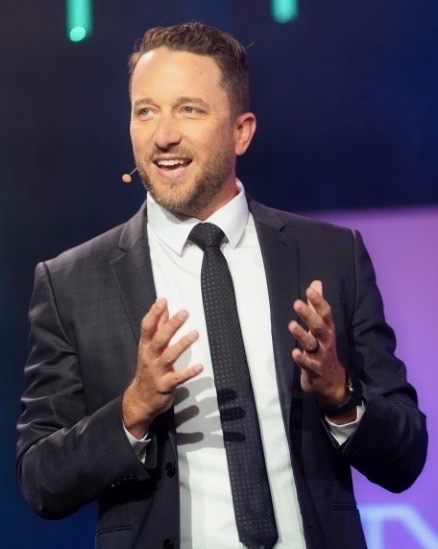
Day 2 – Breakout Session 7 – 1:30-2:00 PM
Room: Fixxology
Your Business Isn’t a Five. What’s Your Next Best Step?
Skyleur Steffensen · RizeCon 2026 · Pocatello
Three weeks before RizeCon, Skyleur Steffensen left corporate America. He’d spent 20 years coaching entrepreneurs in direct sales — from those making $500 a month to those making $50,000 or $100,000 a month — and a year ago had started a flooring franchise alongside that career. Then his wife’s brother died unexpectedly, leaving her to manage both the franchise and the general contractor business her family had planned for her and her brother to take over together. She called Skyleur, crying, and said she couldn’t do it. His wife never says she can’t do something. So he quit his job.
He came to RizeCon three weeks into being a full-time entrepreneur, which means he came with something most speakers at business conferences don’t have: fresh skin in the game. His session was a conversation with the room about what it actually looks like to move a business forward when you’re not sure what to do next.
What he covered
Three questions every business owner should know the answers to. Skyleur opened by asking the room three questions he asks every entrepreneur he meets.
Why did you start your business? The answers in the room: financial freedom. Because I got sick of how my industry operated and knew I could do it better. Because I’m a terrible employee. Because I had real value to add and the ability to add it correctly. These aren’t abstract answers — they’re the answers you have to come back to on the days when a $22,000 flooring contract cancels at 1:00 in the afternoon and then your installer calls to say he got bitten by a dog. On those days, the reason matters.
What are you best at? Figuring things out. Connecting with people — “small brain, big heart.” These are the strengths that transfer most directly into building something, and most business owners don’t take enough time to name them clearly and build around them.
What do you struggle with? Organization. Self-doubt. Hard conversations with employees. Knowing when you’re done and being willing to walk away and go to your kid’s soccer game. (The last one drew more recognition than any of the others.) On a scale of 1 to 5, most people in the room rated their business a 3 or 4. Almost nobody said 5.
Jesse Cole and the Savannah Bananas. The central case study. Jesse Cole was a promising baseball player at Wofford who tore his rotator cuff in his senior year and never made it to the majors. He spent years interning his way up through minor league clubs and eventually became GM of the Gastonia Grizzlies — a team losing $150,000 a year. He had no real salary, no playbook, and nothing but a commitment to figure it out. He ran grandma beauty pageants. He invited a sitting president to be an intern. He spent a decade turning a struggling minor league team around, then went to Savannah, looked at an old historic field where Babe Ruth and Hank Aaron once played, and watched a summer college team play in front of fewer than 200 people. He sold his house to lease the field. He ran a contest to name the new team. A 62-year-old nurse suggested the Bananas. That was the name.
The Savannah Bananas now have a 3.5 million person waiting list. Their tickets are $35 — Jesse Cole wanted them affordable — which means resale prices are far higher. They sell out Yankee Stadium, Fenway Park, and Wrigley Field. Jesse Cole’s insight: he stopped selling baseball and started selling the experience. It’s a party where a baseball game happens to break out. He put the fans first, changed the product, and built something no one else had built in a sport everyone thought they understood.
The point isn’t to build the Savannah Bananas. The point is that the decision to change how you sell yourself and your business — and the commitment to actually do it — can change the trajectory of everything.
The next best step framework, from the Iditarod. Skyleur brought in Dallas Seavey, a six-time Iditarod champion, as a keynote speaker for a previous event. Seavey’s speech was built entirely around one question: what is the next best step? Not the perfect step, not the complete plan — the next best step, given current conditions. He’d have the lead, but his dogs were tired. Keep running? Take a rest? Make the decision that maximizes the probability of finishing first, then make the next one. That’s the same question business owners face every day. Not “how do I turn this around?” but “what is the best thing I can do right now, for me, my team, and what I’m trying to accomplish?”
Skyleur’s application: AI won’t change your business in a month. Understanding your systems won’t either. None of the things discussed across two days of RizeCon will transform a business overnight. What matters is consistent, repeated forward motion — answering the next-best-step question honestly, making that move, and asking it again.
One story that landed
On one of Skyleur’s first full weeks as an entrepreneur, his wife had closed a $22,000 residential flooring job that morning. She called at 1:00 — the customer had changed their mind. He had to tell her that while she was on the phone processing that news, their installer had called. He’d been bitten by a dog and couldn’t do the other job they had booked. That’s two pieces of bad news in a single phone call within weeks of leaving a 20-year career to be all-in on this business. His point: the reason you started your business is what keeps you from deciding it isn’t worth it on that exact kind of day.
“Just because the conditions aren’t exactly to your liking or you don’t feel ready yet, doesn’t mean you get a pass. If you want momentum, you’ll have to create it yourself, right now, by getting up and getting started.” — Ryan Holiday, “The Obstacle Is the Way,” cited by Skyleur Steffensen
“He stopped selling baseball, and he started selling the experience. And it changed everything.” — Skyleur Steffensen, on Jesse Cole and the Savannah Bananas
About the speaker
Skyleur Steffensen spent 20 years coaching entrepreneurs in direct sales, working with everyone from people just starting out to high earners generating $50,000 to $100,000 a month. He recently left corporate America and is now co-owner of a Floor Coverings International franchise and working alongside his wife to lead the family general contractor business she inherited. He came to RizeCon three weeks into being a full-time business owner for the first time in his career, and his session reflected that: someone with 20 years of watching others build businesses, now in it himself.